

If you’ve been baking from scratch for any length of time, you’ve probably started wondering about fresh milled flour vs store bought flour — and whether the difference is actually worth the extra effort. When I made the switch, it didn’t take long to notice changes in flavor, texture, and how my baking felt overall.
Short answer: fresh milled flour is nutritionally richer, more flavorful, and behaves differently in baking than store bought flour — but it does require a grain mill and a small learning curve.
Now let’s talk about what sets fresh milled flour apart from store bought flour — and whether it’s actually worth milling your own.
This post may contain affiliate links, please read my disclosure policy for details.

Fresh Milled Flour vs Store Bought Flour: At a Glance
Below is a quick side-by-side comparison of fresh milled flour vs store bought flour.
| When it’s milled | Right before baking | Weeks or months before purchase |
| Grain components | Bran, germ, and endosperm intact | Often missing bran and germ |
| Nutrients | Naturally occurring vitamins and fats | Nutrients added back through enrichment |
| Flavor | Full, warm, slightly sweet wheat flavor | Neutral, mild |
| Baking behavior | Absorbs more water, benefits from rest | Predictable, standardized |
| Shelf life | Best used freshly milled | Long shelf life |
| Storage | Wheat berries store 20–30+ years when kept cool, dry, and sealed | Flour stores 6–12 months at room temperature (longer if frozen) |
| Tools required | Grain mill | None |
This comparison answers most of what people are searching for — but the details matter, so let’s break it down.
Who Fresh Milled Flour Is Best For
Fresh milled flour isn’t an all-or-nothing switch — it’s a better fit for some bakers than others.
You’ll likely enjoy fresh milled flour if you:
- Bake bread, pancakes, muffins, or sourdough regularly
- Care about using whole ingredients with minimal processing
- Want more control over nutrition and flavor
- Don’t mind a short learning curve with hydration and dough rest times
- Enjoy building kitchen skills instead of relying on convenience products
On the other hand, store bought flour may still make sense if:
- You bake only occasionally
- You need quick, predictable results with no adjustment
- Convenience matters more than ingredient control in this season
Neither choice is wrong. The difference is intention.
Fresh milled flour works best when baking is something you do, not just something you fit in.
What Store Bought Flour Really Is
Most store bought flour — even whole wheat — is milled long before it ever reaches your kitchen. In many cases, it’s been sitting for weeks or months.
Here’s what happens in commercial milling:
- Wheat is processed at an industrial scale for consistency
- The bran and germ are often removed to extend shelf life (these contain oils that can go rancid)
- Vitamins are added back later (that’s what “enriched” means)
- Some flours are bleached or treated for uniformity
This process makes flour predictable, shelf-stable, and easy to transport — which is exactly what commercial baking and distribution require.
The tradeoff is that you’re working with grain that’s been separated from some of its natural components, then reassembled for storage rather than immediate nutrition.

What Fresh Milled Flour Means in My Kitchen
Fresh milled flour is exactly what it sounds like: whole wheat berries ground into flour right before baking.
Nothing is removed. Nothing is added. And nothing sits around oxidizing.
When I mill flour, I’m using the entire grain:
- The bran for fiber and minerals
- The germ for healthy fats and B vitamins
- The endosperm for structure and energy
That’s it.
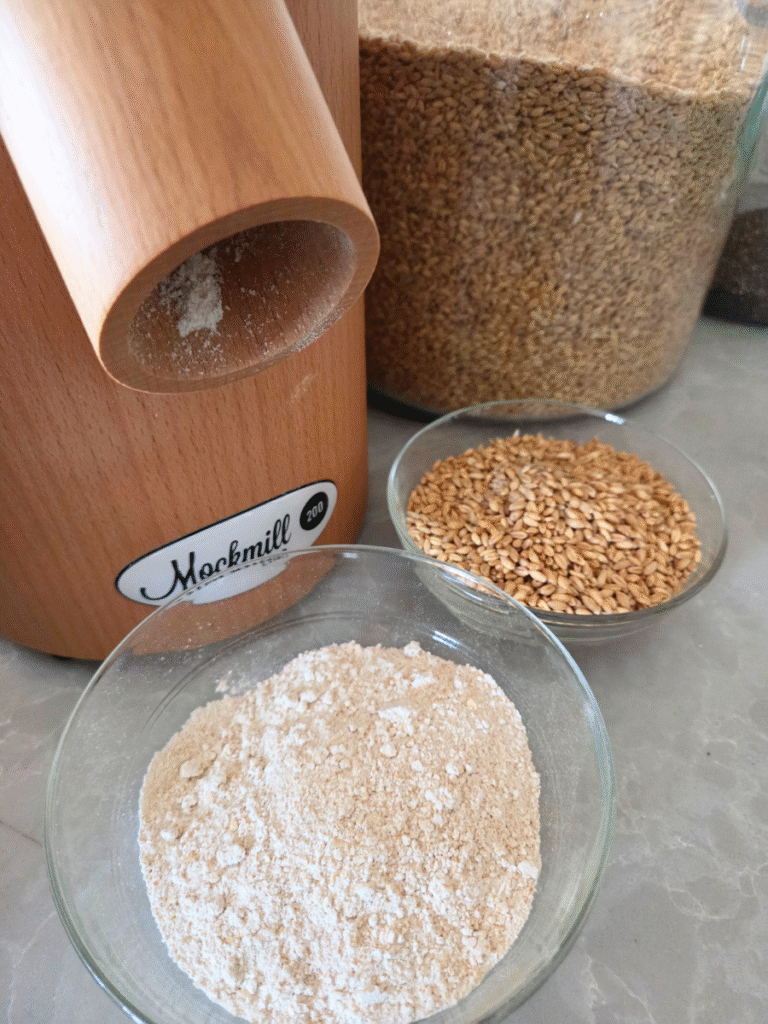
In my kitchen, I use the Mockmill Lino 200 grain mill, which lets me mill exactly what I need when I need it — fine flour for breads and cookies and coarser flour for things like cream of wheat.
This is how flour was used for most of human history. Once I experienced it, there was no going back.
The Nutritional Difference Isn’t Subtle
This is where fresh milled flour really changed the way I think about baking.
When wheat is milled, the nutrient-rich germ begins to oxidize. According to food science research, whole grain flour loses nutritional value within 72 hours of milling due to exposure to oxygen — which is why commercial mills remove the germ in the first place and why enrichment became necessary.
Fresh milled flour:
- Retains natural B vitamins (B1, B2, B3, B6) and vitamin E
- Includes healthy fats from the wheat germ
- Contains intact fiber that supports digestion
- Provides minerals like iron, magnesium, and zinc in their natural form
When I mill flour fresh, I know I’m getting the grain at its nutritional peak — not after weeks of degradation.
Taste: Where I Noticed the Difference First
Nutrition matters — but taste is what convinced me.
Fresh milled flour has a deeper, fuller wheat flavor. There’s a warmth to it. A natural sweetness that you simply don’t get from flour that’s been sitting on a shelf.
In my own kitchen, this is the moment people notice first. Someone will take a bite of bread or a pancake and pause, then ask, “What did you do differently?”
The recipe hasn’t changed. The flour has.
Even simple, everyday bakes like biscuits or waffles taste more satisfying when the grain is fresh.

How Fresh Milled Flour Bakes (Yes, It’s Different)
Fresh milled flour behaves differently because the natural oils, enzymes, and fiber haven’t been degraded by time or processing.
Here’s what I’ve learned through trial and experience:
At first, dough can feel heavier or stickier. But once I started allowing the flour time to fully hydrate, everything changed. The dough became easier to handle and far more forgiving.
Now, baking with fresh milled flour feels intuitive — not complicated.
Digestion: What Changed for Me
One of the biggest surprises for me wasn’t how the bread tasted — it was how it felt afterward.
When baking with fresh milled flour, many people (myself included) notice:
- No more bloating
- Better digestion overall
- More sustained energy
- Fewer blood sugar spikes
I’m not a nutritionist, but the difference was noticeable enough that I started paying attention. The intact fiber and natural fats in fresh flour slow digestion, which is how whole grains were designed to work in the first place.
Processed flour — even whole wheat — behaves differently in the body once it’s been stripped, stored, and reassembled.
Shelf Life: Convenience vs Intention
This is where store-bought flour has the advantage — at least on the surface.
Store-bought flour is convenient. It lasts. It’s always the same.
Fresh milled flour is best used within a few days of milling. But instead of storing flour, I store wheat berries — which can last for decades when kept cool, dry, and sealed — and mill only what I need.
For me, that shift brought more intention into my baking, not more work.

Cost: Is Fresh Milled Flour Worth the Investment?
There is an upfront investment when you start milling flour at home — a grain mill and a supply of wheat berries.
But for me, this decision was never really about saving money.
It was about health.
Before switching to fresh milled flour, my husband would break out in a rash after eating bread — even sourdough. Once we started baking with freshly milled flour, that changed. That alone made the investment worth it.
After learning about the nutritional benefits of fresh milled flour from Sue Becker — and understanding how modern flour processing removes so much of what makes wheat nourishing — I knew this was the missing link in our diet.
When you mill flour fresh, you’re using the entire grain — the bran, germ, and natural oils — exactly as they were meant to be eaten. Nothing has been sitting on a shelf for months. Nothing has been stripped away for storage stability.
And once you understand that difference, the question shifts from “Is this cheaper?” to:
What is your health worth to you?
For our family, the answer was simple.
So… Is Fresh Milled Flour Worth It?
For me, the answer is absolutely yes.
Fresh milled flour means:
- better nourishment
- better digestion
- better flavor
- and the confidence of knowing exactly what’s in our bread
Store-bought flour still has its place, and this isn’t about being perfect. It’s about choosing what aligns with how you want to feed your home.
And for us, fresh milled flour has been one of those choices.
FAQs About Fresh Milled Flour
Final Thoughts
Fresh milled flour isn’t a trend for me. It’s a return to something that makes sense — whole ingredients, handled well, used fresh.
At The Fresh Milled Farmhouse, I don’t chase complicated recipes or food fads. I focus on simple ingredients and techniques that bring more nourishment and satisfaction to everyday baking.
Once you experience fresh milled flour, the question usually isn’t “Why mill my own flour?”
It’s “Why didn’t I start sooner?”




Great post I wish I would have found when I first started fresh milled flour! This is packed full of great info
Okay now I want a grain mill! The benefits and flavor difference are crazy, I can’t wait to give fresh milled flour a try!
I was totally on the fence with a grain milcompletely convinced! convinced!
Such a great informative article. Thank you for sharing. My family loves fresh milled flour – this information completely reinforced that decision.
This is wonderful, thanks for sharing! I currently purchase an organic whole grain einkorn flour but have been looking into getting a grain mill so we can have fresh Milled flour. This is such helpful and encouraging info!
Great read! I am so grateful we made the switch!