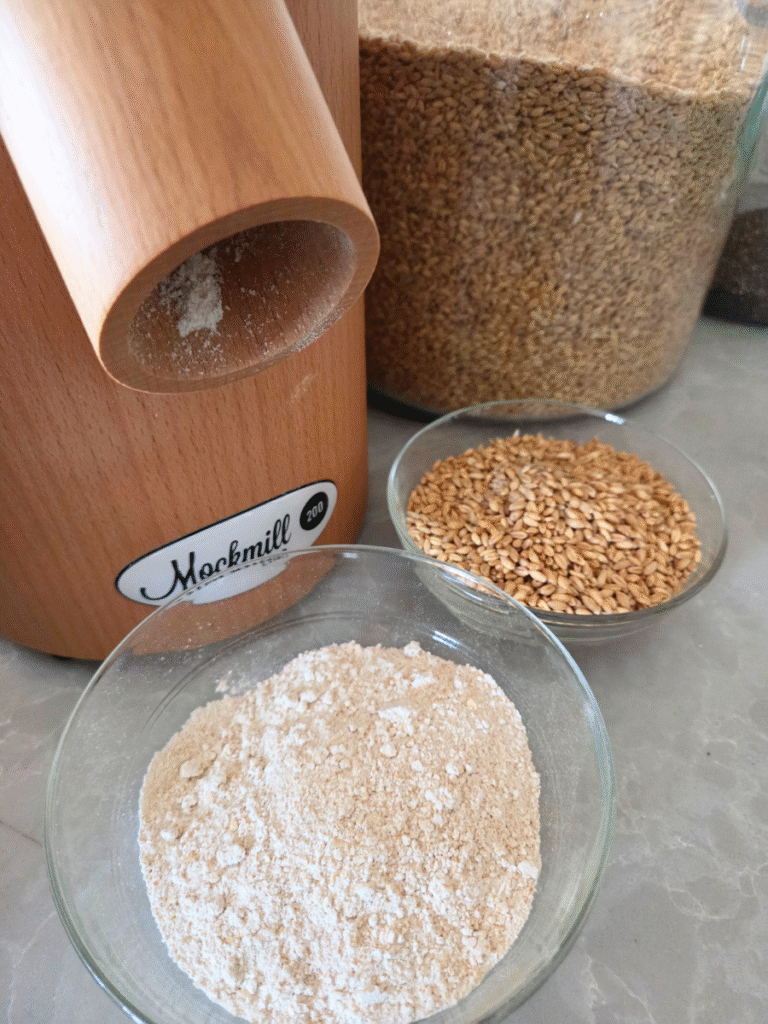
If you’re looking for a fresh milled flour conversion chart to help convert your favorite recipes, this easy guide gives you a simple starting point for figuring out exactly how much freshly milled flour to use.
Freshly milled flour doesn’t measure quite the same way as conventional all-purpose flour, which is why simply swapping cup for cup doesn’t always give you the best results.
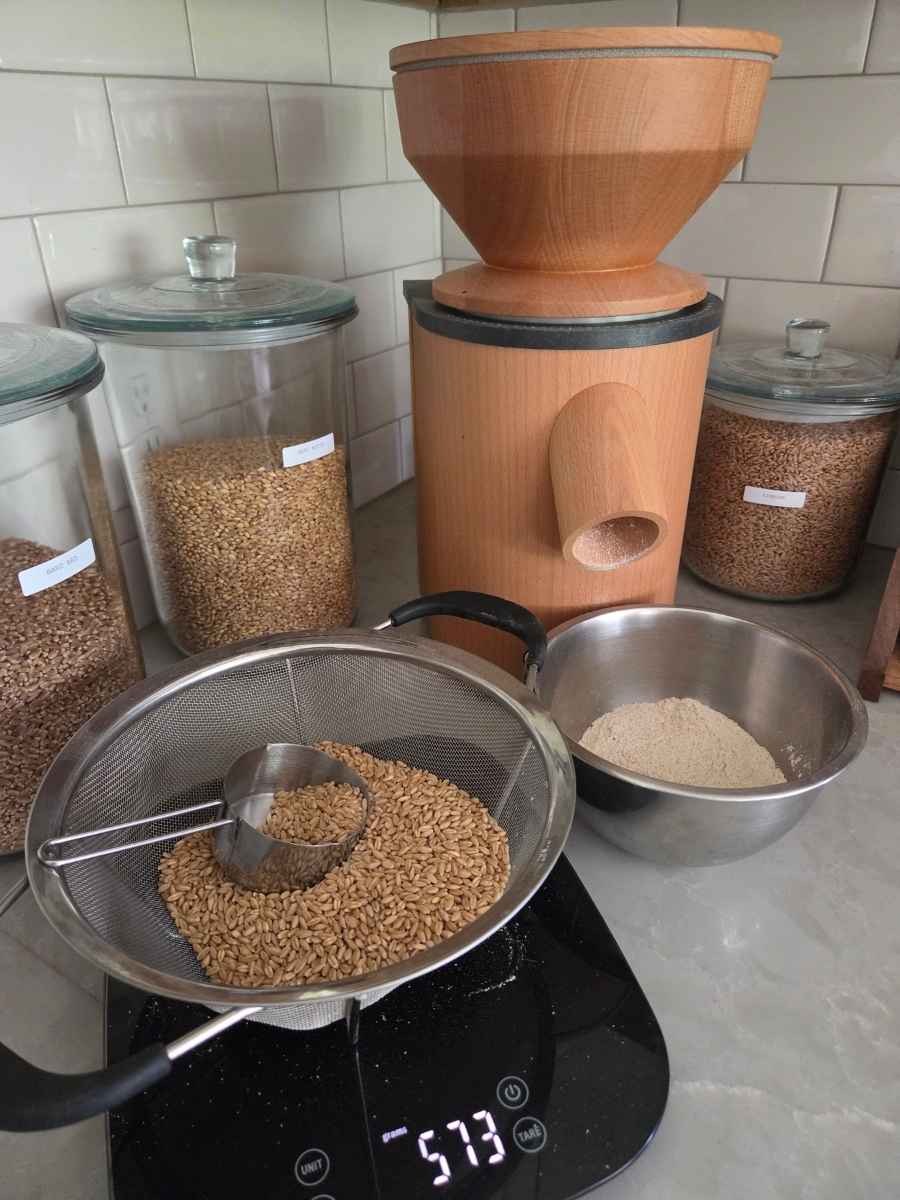
Along with the conversion chart, you’ll find how much wheat to mill, which wheat berries work best for different recipes, and helpful tips for baking with fresh milled flour. You can also download my free Fresh Milled Flour Conversion Chart below, which comes with a handy kitchen guide you can print and keep nearby while you bake—no email or sign-up required.
Fresh Milled Flour Conversion Chart
Use this chart as a starting point when converting a recipe written with all-purpose or bread flour to freshly milled flour.
| Recipe Calls For | Fresh Milled Flour |
| ⅛ cup | 16 g |
| ¼ cup | 33 g |
| ⅓ cup | 43 g |
| ½ cup | 65 g |
| ⅔ cup | 87 g |
| ¾ cup | 98 g |
| 1 cup | 130 g |
| 1¼ cups | 163 g |
| 1½ cups | 195 g |
| 1¾ cups | 228 g |
| 2 cups | 260 g |
| 2¼ cups | 293 g |
| 2½ cups | 325 g |
| 2¾ cups | 358 g |
| 3 cups | 390 g |
| 3¼ cups | 423 g |
| 3½ cups | 455 g |
| 4 cups | 520 g |
| 4½ cups | 585 g |
| 5 cups | 650 g |
| 6 cups | 780 g |
For my recipes, I use 130 grams of freshly milled flour for every 1 cup of flour as my standard starting point.
Keep in mind that this is a starting point. Different grains absorb liquid differently, and the type of recipe you’re making can affect how much flour or liquid you’ll ultimately need.
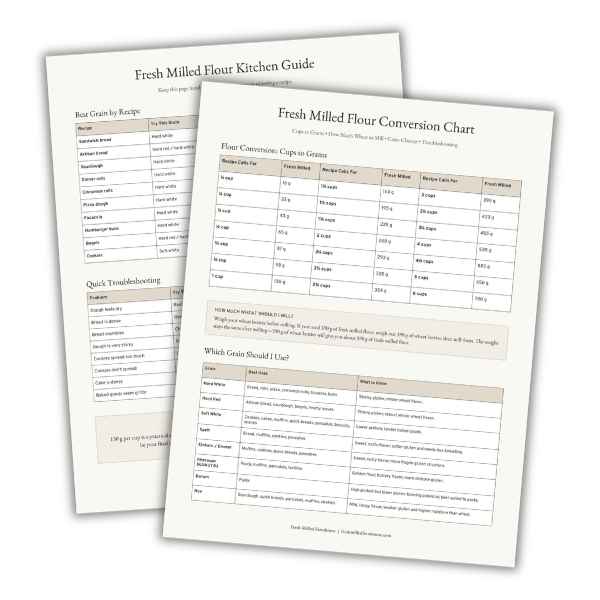
Download the Free Fresh Milled Flour Conversion Chart
Want to keep this chart handy in your kitchen? Click the button below to download my free printable Fresh Milled Flour Conversion Chart, plus a helpful kitchen guide to make baking with fresh milled flour a little easier.
The printable includes:
- Fresh milled flour cups-to-grams conversion chart
- How much wheat to mill
- Guide to hard white, hard red, soft white, spelt, einkorn, khorasan, durum, and rye
- Best grain to use for different recipes
- Quick troubleshooting guide for fresh milled flour
No email or sign-up required. Just download it, print it, and keep it with your favorite recipes.
How Much Wheat Should I Mill?
This is one of my favorite things about baking by weight: figuring out how much wheat to mill is actually really simple.
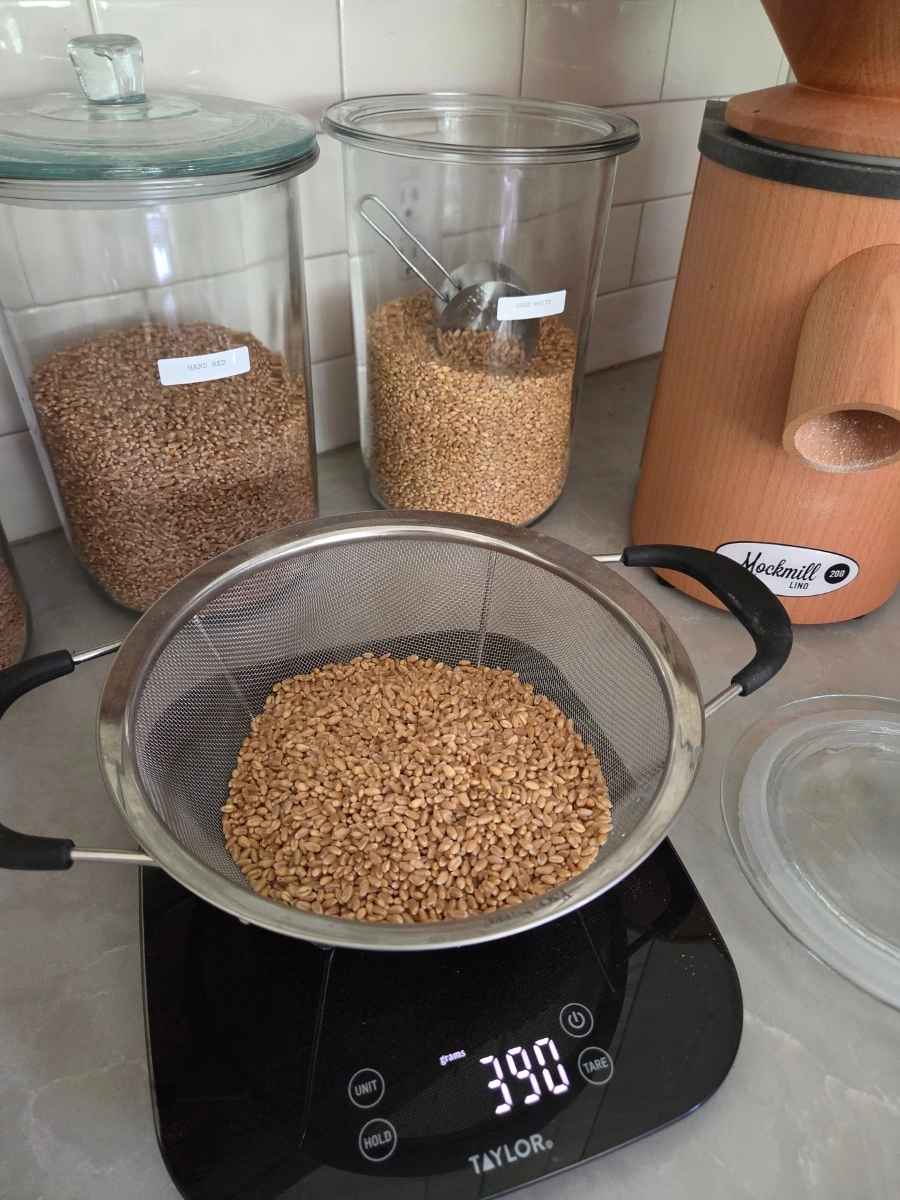
If you need 390 grams of freshly milled flour, weigh out approximately 390 grams of wheat berries and mill them.
Because you’re using the entire wheat berry, the weight doesn’t substantially change just because you’ve turned the grain into flour.
| Fresh Flour Needed | Wheat Berries to Mill |
| 65 g | ~65 g |
| 98 g | ~98 g |
| 130 g | ~130 g |
| 195 g | ~195 g |
| 260 g | ~260 g |
| 325 g | ~325 g |
| 390 g | ~390 g |
| 455 g | ~455 g |
| 520 g | ~520 g |
| 650 g | ~650 g |
| 780 g | ~780 g |
I usually recommend milling just a little extra since a small amount of flour can remain inside your grain mill.
If you’re new to milling your own flour, you may also enjoy reading about the benefits of fresh milled flour and what I wish I had known sooner.
Why I Recommend Weighing Wheat Berries Instead of Measuring Them in Cups
You’ll sometimes see conversions such as “⅔ cup wheat berries makes 1 cup of flour.”
While volume conversions can be helpful for a quick estimate, weighing your grain is much more accurate.
Different grains vary in size and density, and the type of grain and fineness of the grind can affect how freshly milled flour settles.
If your recipe needs 390 grams of fresh milled flour, the easiest method is simply to weigh approximately 390 grams of grain and mill it.
No guessing how many cups of wheat berries you’ll need, and much less leftover flour.
Why Does Fresh Milled Flour Measure Differently?
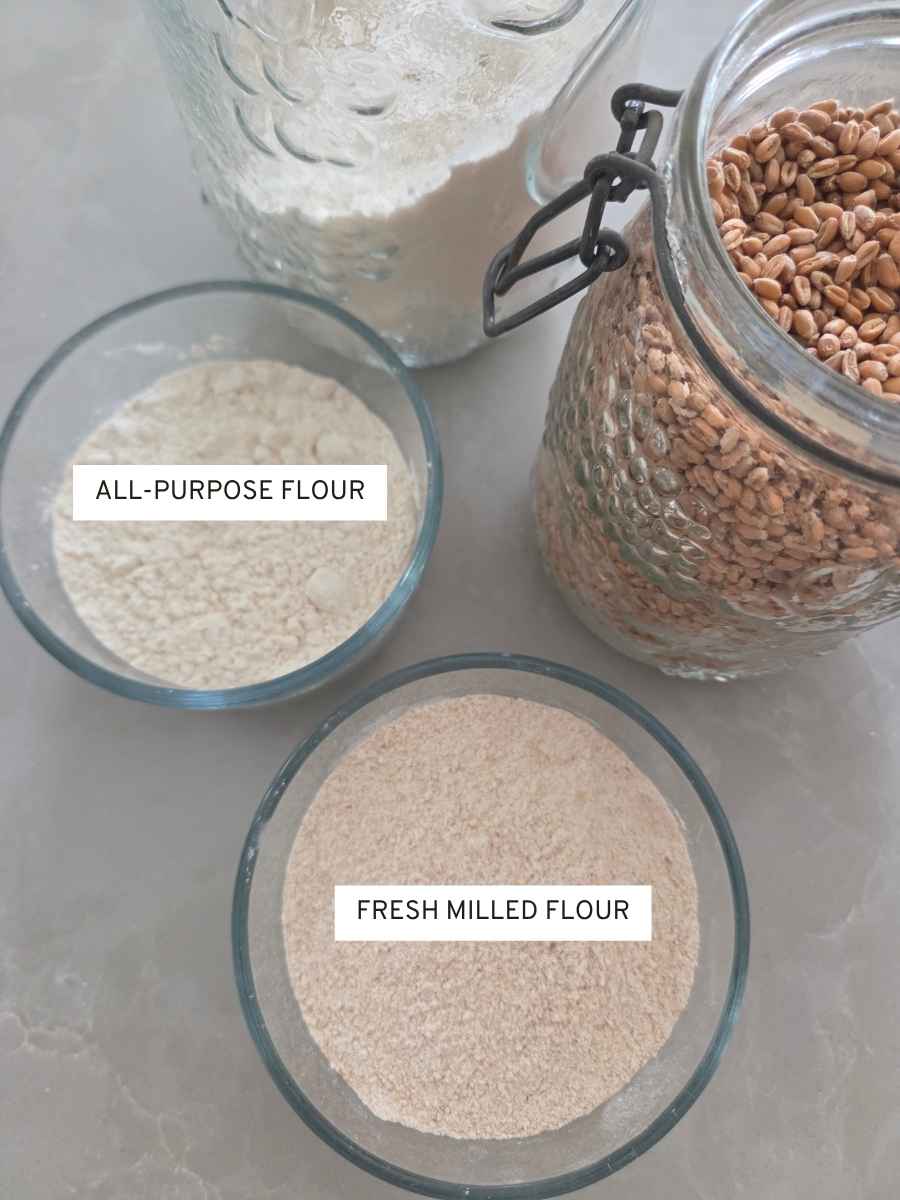
When you mill wheat berries at home, you use the entire wheat berry—the bran, germ, and endosperm.
All-purpose flour goes through refining, which removes the bran and germ.
Freshly milled whole-grain flour also has a different texture and density than conventional white flour. That means measuring both flours with a measuring cup isn’t necessarily an equal exchange.
This is one reason I prefer using a kitchen scale when baking with freshly milled flour. It’s more consistent and takes a lot of the guesswork out of converting recipes.
If you’re curious about how freshly milled flour compares beyond just the way it measures, I break down the differences in my fresh milled flour vs. store-bought flour post.
Can I Substitute Fresh Milled Flour for All-Purpose Flour?
Yes! You can convert many conventional recipes to use fresh milled flour.
For recipes calling for all-purpose or bread flour, I use 130 grams of freshly milled flour per cup of flour called for as my starting point.
However, don’t be afraid to make small adjustments. I sometimes find that a recipe does better with closer to 140 grams of freshly milled flour for every cup of all-purpose flour.
Freshly milled whole-grain flour behaves differently depending on the grain you use and the recipe you’re making. A loaf of yeast bread has very different requirements than a batch of chocolate chip cookies.
The goal isn’t to blindly follow a conversion number. It’s to use the chart as your starting point and then pay attention to the dough or batter.
Does Fresh Milled Flour Need More Liquid?
Sometimes, but I don’t recommend automatically adding extra liquid as soon as you convert a recipe.
Fresh milled flour contains the bran and germ and can continue absorbing moisture as a dough or batter rests.
I prefer to mix the recipe first and give the flour time to hydrate before deciding whether it needs additional liquid.
For many recipes, a 20–30-minute rest can make a noticeable difference.
After resting, look at the dough rather than relying only on the original recipe. If it still seems too dry, add additional liquid a little at a time.
Hard Wheat vs. Soft Wheat: Which Should I Use?
Choosing the right wheat berry is just as important as using the right amount.
You can get the flour conversion exactly right and still end up disappointed if you choose a grain that doesn’t work well for what you’re baking.
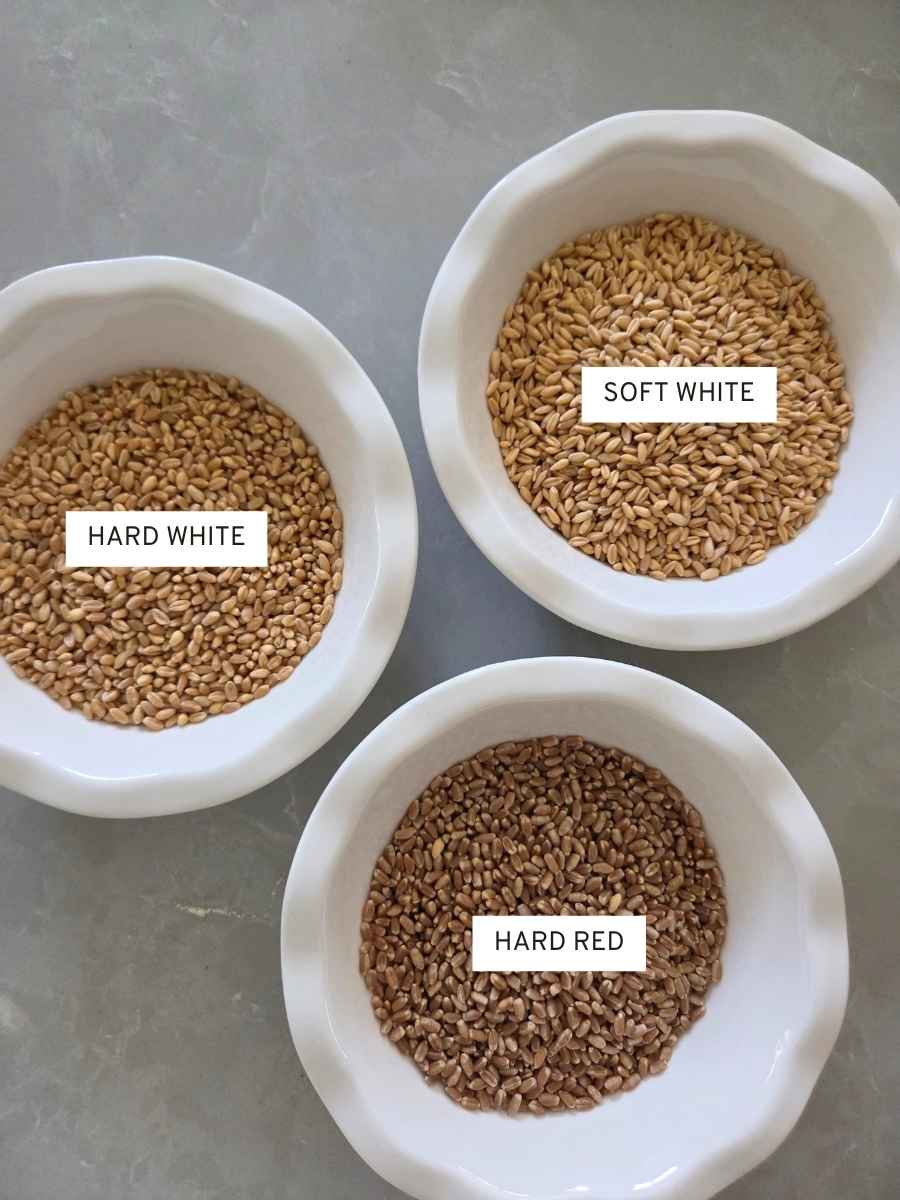
Hard White Wheat
Hard white wheat is my go-to for recipes that need good gluten development but where I want a milder wheat flavor.
It’s especially good for:
- Sandwich bread
- Dinner rolls
- Cinnamon rolls
- Pizza dough
- Hamburger buns
- Focaccia
- Yeast breads
Hard Red Wheat
Hard red wheat also has the protein needed for yeast breads, but it has a stronger, more traditional whole-wheat flavor.
Try it for:
- Artisan breads
- Sourdough
- Bagels
- Hearty sandwich bread
- Dinner rolls
Soft White Wheat
Soft white wheat is lower in protein and makes more tender baked goods that use baking powder or baking soda for leavening.
It’s one of my favorite choices for:
Fresh Milled Flour Grain Guide
Here’s a quick reference for choosing which wheat berry to pull out of the pantry.
| What You’re Making | Best Wheat to Try |
| Sandwich bread | Hard white wheat |
| Artisan bread | Hard red or hard white wheat |
| Sourdough bread | Hard white or hard red wheat |
| Dinner rolls | Hard white wheat |
| Cinnamon rolls | Hard white wheat |
| Pizza dough | Hard white wheat |
| Focaccia | Hard white wheat |
| Hamburger buns | Hard white wheat |
| Bagels | Hard red or hard white wheat |
| Cookies | Soft white wheat |
| Brownies | Soft white wheat |
| Cake | Soft white wheat |
| Cupcakes | Soft white wheat |
| Muffins | Soft white wheat |
| Banana bread | Soft white wheat |
| Zucchini bread | Soft white wheat |
| Pancakes | Soft white wheat |
| Waffles | Soft white wheat |
| Biscuits | Soft white wheat |
| Scones | Soft white wheat |
| Pie crust | Soft white wheat |
| Crackers | Soft white or hard white wheat |
| Tortillas | Hard white wheat |
| Pasta | Durum wheat |
What About Spelt, Einkorn, Khorasan, and Other Grains?
This is where a universal fresh milled flour conversion chart has its limitations.
Not every grain behaves like hard white or soft white wheat. Ancient and alternative grains can have different protein structures, moisture levels, gluten-forming abilities, and baking characteristics, so they may need some adjustments when you use them in a recipe.
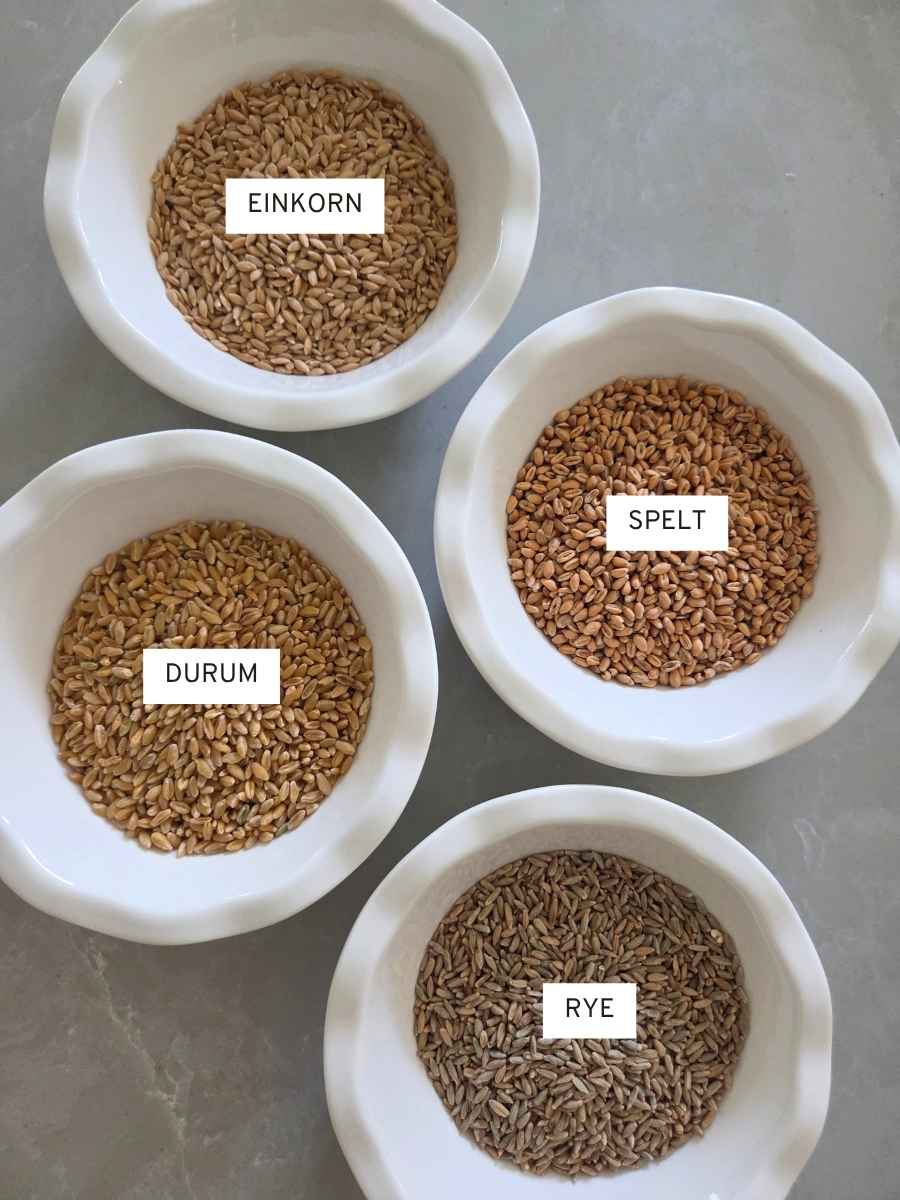
Spelt
Spelt has a soft texture and a sweet, nutty flavor. It has enough protein to develop gluten and works well in both yeast breads and quick breads, but the gluten develops more quickly and needs less kneading than modern bread wheat.
Spelt flour also has a higher moisture content, so when substituting it for wheat flour, you may find that you need more flour. It works especially well in cakes, cookies, muffins, pancakes, and other tender baked goods.
Einkorn and Emmer
Einkorn and emmer have a sweet, nutty flavor and a different protein structure from modern wheat, with less ability to form strong gluten. They work especially well in quick breads, muffins, and pancakes.
You can also use either grain on its own for yeast bread, although it may produce a lower rise than modern hard wheat. Combining them with hard white or hard red wheat can help give yeast breads a better rise.
Khorasan wheat (KAMUT®)
Khorasan wheat (KAMUT®) produces a beautiful golden flour with a rich, buttery flavor. Its gluten structure is more delicate than modern wheat, so a loaf made entirely with khorasan may be somewhat denser. It can also require a little more liquid—or less flour—than a conventional wheat recipe.
Khorasan works especially well for pasta, muffins, pancakes, cookies, tortillas, and other non-yeast breads. You can also use it for yeast bread, and mixing it with hard wheat can give you a lighter loaf.
Durum wheat
Durum wheat is the hardest wheat variety and works especially well for making pasta. Although it is high in protein, it has less gluten-forming potential than common bread wheat, which is one reason it performs better in pasta than in a typical loaf of bread.
Rye
Rye has a much weaker gluten structure than wheat and tends to produce a denser loaf when used on its own. It also absorbs a lot of moisture and can be easy to over-knead. Rye works well in traditional sourdough breads, and mixing it with hard wheat can give you a softer loaf with a higher rise.
Rye isn’t just for bread, either. You can use it in pancakes, muffins, cookies, cakes, brownies, and other quick breads, where its mild, slightly tangy flavor adds something different.
For these grains, use the conversion chart as a starting point rather than an absolute rule. Pay attention to the texture of your dough or batter and adjust the flour or liquid as needed.
Fresh Milled Flour Hydration Chart for Bread
If you’re baking bread by weight, understanding hydration can be even more useful than cup conversions.
Hydration refers to how much water you use in relation to the amount of flour in a recipe.
| Hydration | Water for 500 g Flour |
| 60% | 300 g |
| 65% | 325 g |
| 70% | 350 g |
| 75% | 375 g |
| 80% | 400 g |
| 82% | 410 g |
| 85% | 425 g |
To calculate hydration:
Water weight ÷ flour weight × 100 = hydration percentage
For example, a recipe containing 500 grams of flour and 375 grams of water is 75% hydration.
This is especially helpful when you’re comparing bread recipes or trying to figure out why one dough feels much softer than another.
Troubleshooting Fresh Milled Flour Conversions
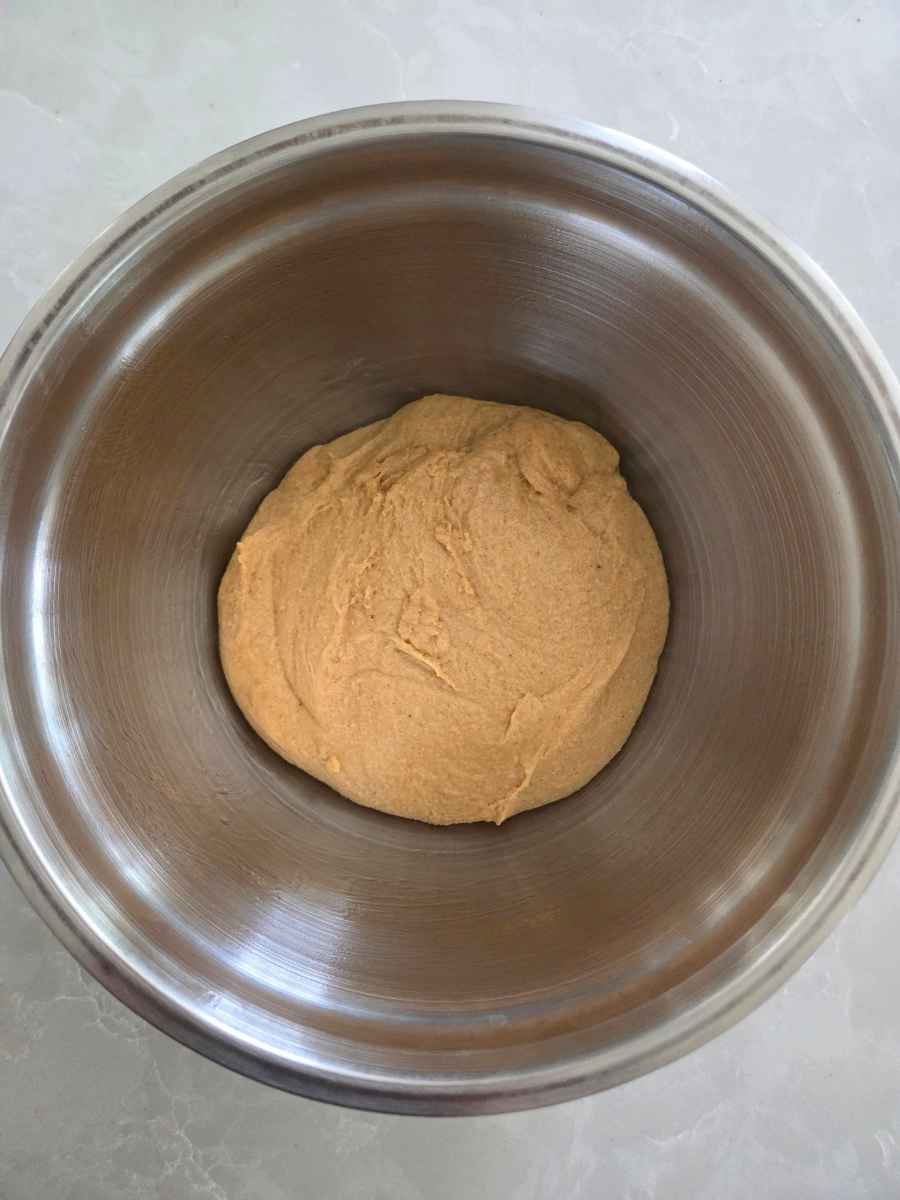
Even with a conversion chart, your dough or batter is always the final guide.
| Problem | What to Try |
| Dough feels dry | Let it rest, then add liquid gradually if needed |
| Bread is dense | Make sure you’re using hard wheat and developing enough gluten |
| Bread crumbles | Check hydration and dough strength |
| Dough is very sticky | Let it rest before adding more flour |
| Cookies spread too much | Chill the dough or slightly increase flour |
| Cookies don’t spread enough | You may have added too much flour |
| Cake is dense | Try soft white wheat and avoid overmixing |
| Muffins are tough | Mix only until the ingredients are combined |
| Baked goods are gritty | Mill finer and/or allow the flour more time to hydrate |
| Bread rises then collapses | Watch for overproofing or insufficient dough strength |
Tips for Successfully Converting Recipes to Fresh Milled Flour
Weigh your wheat berries. A kitchen scale is the best way to get consistent results when baking with fresh milled flour.
Start with 130 grams per cup. When converting a recipe that calls for all-purpose or bread flour, this is my starting point.
Use the right grain. Hard wheat and soft wheat aren’t interchangeable in every recipe. Hard wheat is better for breads that need gluten strength, while soft wheat produces more tender baked goods.
Give the flour time to hydrate. Before adding a lot more flour or liquid, let the dough or batter rest when appropriate.
Don’t immediately add more flour to sticky bread dough. Fresh milled bread dough can change quite a bit after resting and kneading.
Watch the dough, not just the recipe. Grain varieties, milling fineness, humidity, and the other ingredients in a recipe can all affect how much liquid the flour absorbs.
Take notes. If you’re converting a favorite recipe, write down exactly what you changed. Once you get it just right, you’ll have your own fresh milled version to make again and again.
FAQ
The Easiest Fresh Milled Flour Conversion to Remember
You don’t have to memorize the entire chart.
Just remember:
1 cup conventional flour = start with 130 grams freshly milled flour.
And figuring out how much grain to mill is even easier:
Need 260 grams of flour? Start with about 260 grams of wheat berries.
Once you start weighing your grain and flour instead of trying to convert cups of wheat berries into cups of flour, fresh milling becomes much simpler.
And if you’d rather not pull up this post every time you’re baking, don’t forget to grab the free printable Fresh Milled Flour Conversion Chart & Kitchen Guide above. There’s no email or sign-up required—just download it and keep it in your kitchen for the next time you bake.